Inequality between integrals in Lp spaces
In mathematical analysis, Hölder's inequality, named after Otto Hölder, is a fundamental inequality between integrals and an indispensable tool for the study of Lp spaces.
- Theorem (Hölder's inequality). Let (S, Σ, μ) be a measure space and let p, q ∈ [1, ∞] with 1/p + 1/q = 1. Then for all measurable real- or complex-valued functions f and g on S,
-
-

- If, in addition, p, q ∈ (1, ∞) and f ∈ Lp (μ) and g ∈ Lq (μ), then Hölder's inequality becomes an equality if and only if | f| p and |g| q are linearly dependent in L 1(μ), meaning that there exist real numbers α, β ≥ 0, not both of them zero, such that α|f | p = β |g| q μ-almost everywhere.
The numbers p and q above are said to be Hölder conjugates of each other. The special case p = q = 2 gives a form of the Cauchy–Schwarz inequality. Hölder's inequality holds even if || fg ||1 is infinite, the right-hand side also being infinite in that case. Conversely, if f is in Lp (μ) and g is in Lq (μ), then the pointwise product fg is in L 1(μ).
Hölder's inequality is used to prove the Minkowski inequality, which is the triangle inequality in the space Lp (μ), and also to establish that Lq (μ) is the dual space of Lp (μ) for p ∈ [1, ∞).
Hölder's inequality was first found by Leonard James Rogers (1888). Inspired by Rogers' work, Hölder (1889) gave another proof as part of a work developing the concept of convex and concave functions and introducing Jensen's inequality,[1] which was in turn named for work of Johan Jensen building on Hölder's work.[2]
[edit]
Conventions [edit]
The brief statement of Hölder's inequality uses some conventions.
- In the definition of Hölder conjugates, 1/∞ means zero.
- If p, q ∈ [1, ∞), then || f|| p and || g || q stand for the (possibly infinite) expressions
-
-
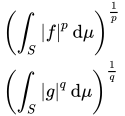
- If p = ∞, then || f||∞ stands for the essential supremum of | f|, similarly for || g ||∞ .
- The notation || f|| p with 1 ≤ p ≤ ∞ is a slight abuse, because in general it is only a norm of f if || f|| p is finite and f is considered as equivalence class of μ-almost everywhere equal functions. If f ∈ Lp (μ) and g ∈ Lq (μ), then the notation is adequate.
- On the right-hand side of Hölder's inequality, 0 × ∞ as well as ∞ × 0 means 0. Multiplying a > 0 with ∞ gives ∞.
Estimates for integrable products [edit]
As above, let f and g denote measurable real- or complex-valued functions defined on S. If || fg ||1 is finite, then the pointwise products of f with g and its complex conjugate function are μ-integrable, the estimate
-

and the similar one for fg hold, and Hölder's inequality can be applied to the right-hand side. In particular, if f and g are in the Hilbert space L 2(μ), then Hölder's inequality for p = q = 2 implies
-

where the angle brackets refer to the inner product of L 2(μ). This is also called Cauchy–Schwarz inequality, but requires for its statement that || f||2 and || g ||2 are finite to make sure that the inner product of f and g is well defined. We may recover the original inequality (for the case p = 2) by using the functions | f| and | g | in place of f and g.
Generalization for probability measures [edit]
If (S, Σ, μ) is a probability space, then p, q ∈ [1, ∞] just need to satisfy 1/p + 1/q ≤ 1, rather than being Hölder conjugates. A combination of Hölder's inequality and Jensen's inequality implies that
-

for all measurable real- or complex-valued functions f and g onS.
Notable special cases [edit]
For the following cases assume that p and q are in the open interval (1,∞) with 1/p + 1/q = 1.
Counting measure [edit]
For the n-dimensional Euclidean space, when the set S is {1, ..., n} with the counting measure, we have
-

Often the following practical form of this is used, for any  :
:
-

For more than two sums, the following generalisation (Chen (2015)) holds, with real positive exponents  and
and  :
:
-

Equality holds iff  .
.
If S = N with the counting measure, then we get Hölder's inequality for sequence spaces:
-

Lebesgue measure [edit]
If S is a measurable subset of R n with the Lebesgue measure, and f and g are measurable real- or complex-valued functions onS, then Hölder inequality is
-

Probability measure [edit]
For the probability space  let
let  denote the expectation operator. For real- or complex-valued random variables
  and
and  on
on  Hölder's inequality reads
-
![{\displaystyle \mathbb {E} [|XY|]\leqslant \left(\mathbb {E} {\bigl [}|X|^{p}{\bigr ]}\right)^{\frac {1}{p}}\left(\mathbb {E} {\bigl [}|Y|^{q}{\bigr ]}\right)^{\frac {1}{q}}.}](https://wikimedia.org/api/rest_v1/media/math/render/svg/1dd0a121fff59e9834e8096b7c5856aab8a1944b)
Let  and define
  Then
Then  is the Hölder conjugate of
  Applying Hölder's inequality to the random variables
  and
and  we obtain
-
![{\displaystyle \mathbb {E} {\bigl [}|X|^{r}{\bigr ]}\leqslant \left(\mathbb {E} {\bigl [}|X|^{s}{\bigr ]}\right)^{\frac {r}{s}}.}](https://wikimedia.org/api/rest_v1/media/math/render/svg/cd851f8c44f4192b9ba15761127d566b226a4ff0)
In particular, if the s th absolute moment is finite, then the r th absolute moment is finite, too. (This also follows from Jensen's inequality.)
Product measure [edit]
For two σ-finite measure spaces (S 1, Σ1, μ 1) and (S 2, Σ2, μ 2) define the product measure space by
-

where S is the Cartesian product of S 1 and S 2 , the σ-algebra Σ arises as product σ-algebra of Σ1 and Σ2 , and μ denotes the product measure of μ 1 and μ 2 . Then Tonelli's theorem allows us to rewrite Hölder's inequality using iterated integrals: Iff and g are Σ-measurable real- or complex-valued functions on the Cartesian productS, then
-

This can be generalized to more than two σ-finite measure spaces.
Vector-valued functions [edit]
Let (S, Σ, μ) denote a σ-finite measure space and suppose that f = (f 1, ..., fn ) and g = (g 1, ..., gn ) are Σ-measurable functions on S, taking values in the n-dimensional real- or complex Euclidean space. By taking the product with the counting measure on {1, ..., n}, we can rewrite the above product measure version of Hölder's inequality in the form
-

If the two integrals on the right-hand side are finite, then equality holds if and only if there exist real numbers α, β ≥ 0, not both of them zero, such that
-

for μ-almost all x in S.
This finite-dimensional version generalizes to functions f and g taking values in a normed space which could be for example a sequence space or an inner product space.
Proof of Hölder's inequality [edit]
There are several proofs of Hölder's inequality; the main idea in the following is Young's inequality for products.
Proof
If || f|| p = 0, then f is zero μ-almost everywhere, and the product fg is zero μ-almost everywhere, hence the left-hand side of Hölder's inequality is zero. The same is true if || g || q = 0. Therefore, we may assume || f|| p > 0 and || g || q > 0 in the following.
If || f|| p = ∞ or || g || q = ∞, then the right-hand side of Hölder's inequality is infinite. Therefore, we may assume that || f|| p and || g || q are in (0, ∞).
If p = ∞ and q = 1, then | fg | ≤ || f||∞ | g | almost everywhere and Hölder's inequality follows from the monotonicity of the Lebesgue integral. Similarly for p = 1 and q = ∞. Therefore, we may assume p, q ∈ (0, 1) ∪ (1,∞). However, to apply Young's inequality for products, we will require p, q ∈ (1,∞)
Dividing f and g by || f|| p and || g || q , respectively, we can assume that
-

We now use Young's inequality for products, which states that whenever  are in (1,∞) with
-
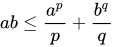
for all nonnegative a and b, where equality is achieved if and only if ap = bq . Hence
-

Integrating both sides gives
-

which proves the claim.
Under the assumptions p ∈ (1, ∞) and || f|| p = || g || q , equality holds if and only if | f| p = | g | q almost everywhere. More generally, if || f|| p and || g || q are in (0, ∞), then Hölder's inequality becomes an equality if and only if there exist real numbers α, β > 0, namely
-

such that
-
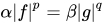 μ-almost everywhere (*).
The case || f|| p = 0 corresponds to β = 0 in (*). The case || g || q = 0 corresponds to α = 0 in (*).
Alternative proof using Jensen's inequality: The function  on (0,∞) is convex because
  , so by Jensen's inequality,
-
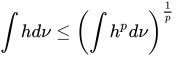
where ν is any probability distribution and h any ν-measurable function. Let μ be any measure, and ν the distribution whose density w.r.t. μ is proportional to  , i.e.
-
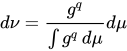
Hence we have, using , hence  , and letting
  ,
,
-

Finally, we get
-

This assumes that f, g are real and non-negative, but the extension to complex functions is straightforward (use the modulus of f, g ). It also assumes that  are neither null nor infinity, and that
  : all these assumptions can also be lifted as in the proof above.
Extremal equality [edit]
Statement [edit]
Assume that 1 ≤ p < ∞ and let q denote the Hölder conjugate. Then for every f ∈ Lp (μ),
-

where max indicates that there actually is a g maximizing the right-hand side. When p = ∞ and if each set A in the σ-field Σ with μ(A) = ∞ contains a subset B ∈ Σ with 0 < μ(B) < ∞ (which is true in particular when μ is σ-finite), then
-

Proof of the extremal equality: By Hölder's inequality, the integrals are well defined and, for 1 ≤ p ≤ ∞,
-

hence the left-hand side is always bounded above by the right-hand side.
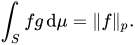
Conversely, for 1 ≤ p ≤ ∞, observe first that the statement is obvious when || f|| p = 0. Therefore, we assume || f|| p > 0 in the following.
If 1 ≤ p < ∞, define g on S by
-

By checking the cases p = 1 and 1 < p < ∞ separately, we see that || g || q = 1 and
-
It remains to consider the case p = ∞. For ε ∈ (0, 1) define
-

Since f is measurable, A ∈ Σ. By the definition of || f||∞ as the essential supremum of f and the assumption || f||∞ > 0, we have μ(A) > 0. Using the additional assumption on the σ-field Σ if necessary, there exists a subset B ∈ Σ of A with 0 < μ(B) < ∞. Define g on S by
-
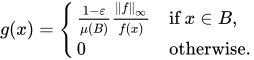
Then g is well-defined, measurable and | g(x)| ≤ 1/μ(B) for x ∈ B , hence || g ||1 ≤ 1. Furthermore,
-

Remarks and examples [edit]
- The equality for
 fails whenever there exists a set
  of infinite measure in the
  -field
  with that has no subset
  that satisfies:
  (the simplest example is the -field containing just the empty set and
  and the measure
  with
with  ) Then the indicator function
  satisfies
  but every
  has to be -almost everywhere constant on
  because it is -measurable, and this constant has to be zero, because
  is -integrable. Therefore, the above supremum for the indicator function is zero and the extremal equality fails.
 - For
 the supremum is in general not attained. As an example, let
  and the counting measure. Define:
-
-

- Then
 For
For 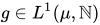 with
with 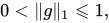 let
let  denote the smallest natural number with
  Then
Then
-
-

Applications [edit]
- The extremal equality is one of the ways for proving the triangle inequality || f 1 + f 2 || p ≤ || f 1 || p + || f 2 || p for all f 1 and f 2 in Lp (μ), see Minkowski inequality.
- Hölder's inequality implies that every f ∈ Lp (μ) defines a bounded (or continuous) linear functional κf on Lq (μ) by the formula
-
-

- The extremal equality (when true) shows that the norm of this functional κf as element of the continuous dual space Lq (μ)* coincides with the norm of f in Lp (μ) (see also the Lp -space article).
Generalization of Hölder's inequality [edit]
Assume that r ∈ (0, ∞] and p 1, ..., pn ∈ (0, ∞] such that
-

where 1/∞ is interpreted as 0 in this equation. Then for all measurable real or complex-valued functions f 1, ..., f n defined on S,
-
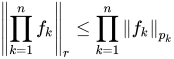
where we interpret any product with a factor of ∞ as ∞ if all factors are positive, but the product is 0 if any factor is 0.
In particular, if  for all
 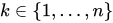 then
then 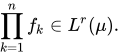
Note: For  contrary to the notation, ||.|| r is in general not a norm because it doesn't satisfy the triangle inequality.
Proof of the generalization: We use Hölder's inequality and mathematical induction. If  then the result is immediate. Let us now pass from
  to
to  Without loss of generality assume that
Case 1: If  then
then
-
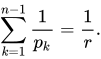
Pulling out the essential supremum of | fn | and using the induction hypothesis, we get
-

Case 2: If  then necessarily
  as well, and then
-
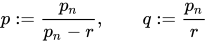
are Hölder conjugates in (1, ∞). Application of Hölder's inequality gives
-

Raising to the power  and rewriting,
-

Since  and
and
-
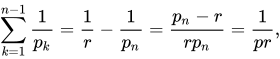
the claimed inequality now follows by using the induction hypothesis.
Interpolation [edit]
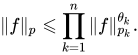
Let p 1, ..., p n ∈ (0, ∞] and let θ 1, ..., θ n ∈ (0, 1) denote weights with θ 1 + ... + θn = 1. Define  as the weighted harmonic mean, that is,
-
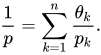
Given measurable real- or complex-valued functions  on S, then the above generalization of Hölder's inequality gives
-

In particular, taking  gives
gives
-
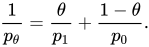
Specifying further θ 1 = θ and θ 2 = 1-θ , in the case  we obtain the interpolation result (Littlewood's inequality)
-

for  and
and
-
An application of Hölder gives Lyapunov's inequality: If
-

then
-

and in particular
-

Both Littlewood and Lyapunov imply that if  then
then  for all
Reverse Hölder inequality [edit]
Assume that p ∈ (1, ∞) and that the measure space (S, Σ, μ) satisfies μ(S) > 0. Then for all measurable real- or complex-valued functions f and g on S such that g(s) ≠ 0 for μ-almost all s ∈ S ,
-
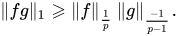
If
-

then the reverse Hölder inequality is an equality if and only if
-

Note: The expressions:
-
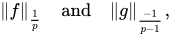
are not norms, they are just compact notations for
-

Proof of the reverse Hölder inequality: Note that p and
-
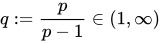
are Hölder conjugates. Application of Hölder's inequality gives
-
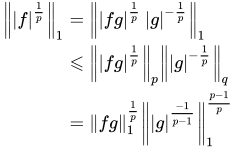
Raising to the power p gives us:
-
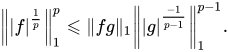
Therefore:
-
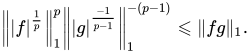
Now we just need to recall our notation.
Since g is not almost everywhere equal to the zero function, we can have equality if and only if there exists a constant α ≥ 0 such that | fg | = α | g |−q/p almost everywhere. Solving for the absolute value of f gives the claim.
Conditional Hölder inequality [edit]
Let (Ω, F,  ) be a probability space, G ⊂ F a sub-σ-algebra, and p, q ∈ (1, ∞) Hölder conjugates, meaning that 1/p + 1/q = 1. Then for all real- or complex-valued random variables X and Y onΩ,
-
![\mathbb {E} {\bigl [}|XY|{\big |}\,{\mathcal {G}}{\bigr ]}\leq {\bigl (}\mathbb {E} {\bigl [}|X|^{p}{\big |}\,{\mathcal {G}}{\bigr ]}{\bigr )}^{\frac {1}{p}}\,{\bigl (}\mathbb {E} {\bigl [}|Y|^{q}{\big |}\,{\mathcal {G}}{\bigr ]}{\bigr )}^{\frac {1}{q}}\qquad \mathbb {P} {\text{-almost surely.}}](https://wikimedia.org/api/rest_v1/media/math/render/svg/e6089e918b0a4facc49f7cedbf332e697a1628b2)
Remarks:
- If a non-negative random variable Z has infinite expected value, then its conditional expectation is defined by
-
-
![\mathbb {E} [Z|{\mathcal {G}}]=\sup _{n\in \mathbb {N} }\,\mathbb {E} [\min\{Z,n\}|{\mathcal {G}}]\quad {\text{a.s.}}](https://wikimedia.org/api/rest_v1/media/math/render/svg/a4a4a866e15be4bdc2156438f9cf3d1a5db57683)
- On the right-hand side of the conditional Hölder inequality, 0 times ∞ as well as ∞ times 0 means 0. Multiplying a > 0 with ∞ gives ∞.
Proof of the conditional Hölder inequality: Define the random variables
-
![U={\bigl (}\mathbb {E} {\bigl [}|X|^{p}{\big |}\,{\mathcal {G}}{\bigr ]}{\bigr )}^{\frac {1}{p}},\qquad V={\bigl (}\mathbb {E} {\bigl [}|Y|^{q}{\big |}\,{\mathcal {G}}{\bigr ]}{\bigr )}^{\frac {1}{q}}](https://wikimedia.org/api/rest_v1/media/math/render/svg/9e9e39640f4dc158a566bee7b5696f5140631f0a)
and note that they are measurable with respect to the sub-σ-algebra. Since
-
![\mathbb {E} {\bigl [}|X|^{p}1_{\{U=0\}}{\bigr ]}=\mathbb {E} {\bigl [}1_{\{U=0\}}\underbrace {\mathbb {E} {\bigl [}|X|^{p}{\big |}\,{\mathcal {G}}{\bigr ]}} _{=\,U^{p}}{\bigr ]}=0,](https://wikimedia.org/api/rest_v1/media/math/render/svg/69905a3f486cbf984d99a2f968dcaf08195f637e)
it follows that | X | = 0 a.s. on the set {U = 0}. Similarly, | Y | = 0 a.s. on the set {V = 0}, hence
-
![\mathbb {E} {\bigl [}|XY|{\big |}\,{\mathcal {G}}{\bigr ]}=0\qquad {\text{a.s. on }}\{U=0\}\cup \{V=0\}](https://wikimedia.org/api/rest_v1/media/math/render/svg/e863f914e038ef3ab57ac04eaae91d3ff6da6550)
and the conditional Hölder inequality holds on this set. On the set
-

the right-hand side is infinite and the conditional Hölder inequality holds, too. Dividing by the right-hand side, it therefore remains to show that
-
![{\frac {\mathbb {E} {\bigl [}|XY|{\big |}\,{\mathcal {G}}{\bigr ]}}{UV}}\leq 1\qquad {\text{a.s. on the set }}H:=\{0<U<\infty ,\,0<V<\infty \}.](https://wikimedia.org/api/rest_v1/media/math/render/svg/456a39a139248e5750c23688a36b7b3aeb750aff)
This is done by verifying that the inequality holds after integration over an arbitrary
-

Using the measurability of U, V, 1 G with respect to the sub-σ-algebra, the rules for conditional expectations, Hölder's inequality and 1/p + 1/q = 1, we see that
-
![{\begin{aligned}\mathbb {E} {\biggl [}{\frac {\mathbb {E} {\bigl [}|XY|{\big |}\,{\mathcal {G}}{\bigr ]}}{UV}}1_{G}{\biggr ]}&=\mathbb {E} {\biggl [}\mathbb {E} {\biggl [}{\frac {|XY|}{UV}}1_{G}{\bigg |}\,{\mathcal {G}}{\biggr ]}{\biggr ]}\\&=\mathbb {E} {\biggl [}{\frac {|X|}{U}}1_{G}\cdot {\frac {|Y|}{V}}1_{G}{\biggr ]}\\&\leq {\biggl (}\mathbb {E} {\biggl [}{\frac {|X|^{p}}{U^{p}}}1_{G}{\biggr ]}{\biggr )}^{\frac {1}{p}}{\biggl (}\mathbb {E} {\biggl [}{\frac {|Y|^{q}}{V^{q}}}1_{G}{\biggr ]}{\biggr )}^{\frac {1}{q}}\\&={\biggl (}\mathbb {E} {\biggl [}\underbrace {\frac {\mathbb {E} {\bigl [}|X|^{p}{\big |}\,{\mathcal {G}}{\bigr ]}}{U^{p}}} _{=\,1{\text{ a.s. on }}G}1_{G}{\biggr ]}{\biggr )}^{\frac {1}{p}}{\biggl (}\mathbb {E} {\biggl [}\underbrace {\frac {\mathbb {E} {\bigl [}|Y|^{q}{\big |}\,{\mathcal {G}}{\bigr ]}}{V^{p}}} _{=\,1{\text{ a.s. on }}G}1_{G}{\biggr ]}{\biggr )}^{\frac {1}{q}}\\&=\mathbb {E} {\bigl [}1_{G}{\bigr ]}.\end{aligned}}](https://wikimedia.org/api/rest_v1/media/math/render/svg/82ea3e2364949d7450d60a5bb32972aadc0db999)
Hölder's inequality for increasing seminorms [edit]
Let S be a set and let  be the space of all complex-valued functions on S. Let N be an increasing seminorm on
  meaning that, for all real-valued functions
  we have the following implication (the seminorm is also allowed to attain the value ∞):
-

Then:
-

where the numbers and  are Hölder conjugates.[3]
Remark: If (S, Σ, μ) is a measure space and  is the upper Lebesgue integral of
  then the restriction of N to all Σ-measurable functions gives the usual version of Hölder's inequality.
Distances based on Hölder inequality [edit]
Hölder inequality can be used to define statistical dissimilarity measures[4] between probability distributions. Those Hölder divergences are projective: They do not depend on the normalization factor of densities.
See also [edit]
- Cauchy–Schwarz inequality
- Minkowski inequality
- Jensen's inequality
- Young's inequality for products
- Clarkson's inequalities
- Brascamp–Lieb inequality
Citations [edit]
- ^ Maligranda, Lech (1998), "Why Hölder's inequality should be called Rogers' inequality", Mathematical Inequalities & Applications, 1 (1): 69–83, doi:10.7153/mia-01-05, MR 1492911
- ^ Guessab, A.; Schmeisser, G. (2013), "Necessary and sufficient conditions for the validity of Jensen's inequality", Archiv der Mathematik, 100 (6): 561–570, doi:10.1007/s00013-013-0522-3, MR 3069109,
under the additional assumption that  exists, this inequality was already obtained by Hölder in 1889
- ^ For a proof see (Trèves 1967, Lemma 20.1, pp. 205–206).
- ^ Nielsen, Frank; Sun, Ke; Marchand-Maillet, Stephane (2017). "On Hölder projective divergences". Entropy. 3 (19): 122. arXiv:1701.03916. Bibcode:2017Entrp..19..122N. doi:10.3390/e19030122.
References [edit]
- Grinshpan, A. Z. (2010), "Weighted inequalities and negative binomials", Advances in Applied Mathematics, 45 (4): 564–606, doi:10.1016/j.aam.2010.04.004
- Hardy, G. H.; Littlewood, J. E.; Pólya, G. (1934), Inequalities, Cambridge University Press, pp. XII+314, ISBN0-521-35880-9, JFM 60.0169.01, Zbl 0010.10703 .
- Hölder, O. (1889), "Ueber einen Mittelwertsatz", Nachrichten von der Königl. Gesellschaft der Wissenschaften und der Georg-Augusts-Universität zu Göttingen, Band (in German), 1889 (2): 38–47, JFM 21.0260.07 . Available at Digi Zeitschriften.
- Kuptsov, L. P. (2001) [1994], "Hölder inequality", Encyclopedia of Mathematics, EMS Press .
- Narici, Lawrence; Beckenstein, Edward (2011). Topological Vector Spaces. Pure and applied mathematics (Second ed.). Boca Raton, FL: CRC Press. ISBN978-1584888666. OCLC 144216834.
- Rogers, L. J. (February 1888), "An extension of a certain theorem in inequalities", Messenger of Mathematics, New Series, XVII (10): 145–150, JFM 20.0254.02, archived from the original on August 21, 2007 .
- Trèves, François (1967), Topological Vector Spaces, Distributions and Kernels, Pure and Applied Mathematics. A Series of Monographs and Textbooks, vol. 25, New York, London: Academic Press, MR 0225131, Zbl 0171.10402 .
- Trèves, François (2006) [1967]. Topological Vector Spaces, Distributions and Kernels. Mineola, N.Y.: Dover Publications. ISBN978-0-486-45352-1. OCLC 853623322.
External links [edit]
- Chen, Evan (2015), A Brief Introduction to Olympiad Inequalities (PDF) .
- Kuttler, Kenneth (2007), An Introduction to Linear Algebra (PDF), Online e-book in PDF format, Brigham Young University .
- Lohwater, Arthur (1982), Introduction to Inequalities (PDF) .
- Archived at Ghostarchive and the Wayback Machine: Tisdell, Chris (2012), Holder's Inequality, Online video on Dr Chris Tisdell's YouTube channel .
0 Response to "Show That if Equality Holds in This Inequality Then F is Absolutely Continuous on a B"
Post a Comment