How Long Can It Take for Second Baby Goat to Deliver
Preparing For Kidding
Kidding may occur on pasture, or you lot may need to provide does with a make clean, dry, well-ventilated shelter, depending on the weather in your area and your preference. It is wise to watch animals carefully, in example they should require assistance. Harbinger or pine shavings, or an cheap hay, can exist used for bedding in shelters, if desired. Pregnant animals volition become an enlarged udder starting ane to six weeks prior to kidding. Some signs that parturition, or kidding, is approaching include hollowness on either side of the doe'due south tail, the doe isolating herself from the rest of the herd, and an enlarged udder and teats that begin to fill with milk.
At ii weeks prior to kidding, the muscles of the ligaments on both sides of the doe will begin to soften and relax. During the final three to four days earlier labor, the udder volition appear quite large equally it fills with milk. Does that kid for the first time may not show this development until two weeks or more after kidding. One to ii days before labor, the teats become enlarged and look full of milk; the does will begin to show signs of nervousness: pawing at the footing, acting restless, and lying downwards. The doe will also expel a sparse mucous discharge from the vulva, which volition gradually become thicker as parturition approaches. The last 12 hours of labor may consist of continuous bleating sounds by the doe. The tail may exist direct out or slightly elevated. The outset several vertebrae of the spine in front of the tail head may announced to stand higher and taller than usual.
A normal delivery ordinarily takes five hours. Cervix dilation (which yous cannot see) usually requires four hours, and so one hour is required for the commitment of the offspring. The kid should exist correct side upwards with the front feet kickoff, with legs extended and the caput lying betwixt the knees and pasterns in a "diving" position. After the h2o sac breaks, the doe should kickoff to requite nascency inside xxx minutes to ane hr. If the doe is pushing very difficult for longer than xxx minutes and a water sac or kid does not appear, information technology may be necessary to assist the doe yourself or contact a veterinarian for further help. Generally, if the doe is still in active labor and is pushing later on having a kid and does not laissez passer placenta or another kid within thirty minutes to i hour, assist may be needed. Some does may take longer between kids without problems. If they are up cleaning a kid and appear comfortable, longer than 1 hour may exist adequate. Goats may have 3, or rarely, more kids. The procedure will repeat with each child.
When the kid is born, try to let the cord interruption naturally, but if the sac is not cleaved, break information technology for the doe. Newborn kids are stimulated by the doe licking it clean. Normally, kids begin to vocalize as the doe cleans them. Normal kids attempt to stand within a few hours later on birth and look for the udder to nurse. Respiration in the kid is stimulated by the doe licking the kid. If the child appears lifeless, vigorously rub the child with a towel to stimulate respiration, and make clean out the mucus from the nose and mouth with a finger or soft cloth. Placing a piece of straw upwards the nose, which will trigger a sneezing reaction, tin also assistance articulate the airways. If the kid is nonetheless having bug, giving it short, firm, but gentle, compressions with the fingers in the middle of the eye until it cries may aid. One time the doe has kidded, make sure she has shed her placenta. Contact your veterinarian if the placenta has not detached after 12 to 18 hours.
For more information virtually kidding, see: Kidding Management or Getting Ready For Lambing and Kidding.
Difficult Births (Dystocia)
Normal presentation of the kid is two front legs and olfactory organ frontward in a diving position. If there is whatever variation in the presentation of the kid, and then the delivery will not exist normal.

Normal kidding position
Abnormal presentations include a kid position that is fully breached, with the buttocks or dorsum feet appearing commencement. If the dorsum anxiety appear starting time, no assistance is needed. If the buttocks/tail is presented, the kid tin can be pushed back some, the dorsum anxiety can be eased upward into the position shown below (protect the uterus from puncture of feet using your hand), and kidding tin can be assisted if needed after that.
A person assisting the doe should trim his or her nails, remove all jewelry (rings), and put on latex gloves or thoroughly launder his or her hands. Antibiotics may exist needed for does that have been given assistance, depending upon the severity of the problem.
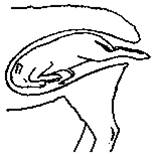
Breach kidding position
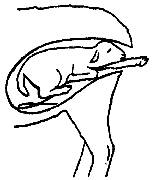
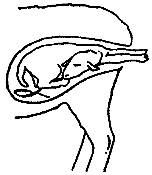
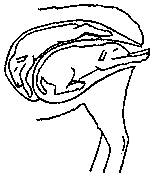
Another aberrant position may include the caput presenting itself, with one human foot visible, and the doe straining unproductively. See below for additional breached positions:
| Elbow lock | One leg back | Both legs back |
| Head dorsum | Twins front and back | Twins four legs |
| Tail only |


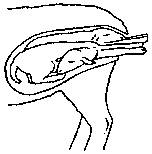
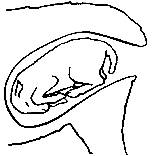
Care around the time of birth (neonatal care)
Later birth, make clean the mucus abroad from the olfactory organ, mouth, and throat. Counterbalance the kid, tag the ear, and dip the navel cord in 7-per centum iodine to forestall belly button joint disease. Make certain each child receives its female parent's first milk (colostrum) inside the start 24 hours later on birth (within the commencement ane to four hours is best). The showtime milk is rich in antibodies that helps the child fight diseases. The sooner the kid nurses, the more antibodies the animal tin can blot. After 24 hours, the child'south ability to absorb antibodies from the colostrum is minimal, and shortly after that, none can be captivated. In the case of orphans, provide colostrum from another doe that has just given birth, keep frozen colostrum on manus, or use a good colostrum replacer or supplement. Efforts tin can also be fabricated to force a doe that has given birth to a single kid to adopt an orphan.
The adoption process between animals may not be as easy equally it seems. First, endeavour isolating the adopting parent in a small pen with the orphan. Hold or securely tie the doe, allowing the kid to nurse the doe several times during the solar day, or use a type of grafting gate, available commercially at several equipment websites (or brand your own). Sometimes, using a smelly menthol-type rub in the doe's nose, on each kid's face, rump, and belly tin can make all the kids odour the same. Hopefully, later seven to 10 days of the kid(s) nursing the doe, she will call back the kid(s) is hers and make up one's mind to keep it as her own. If this process does not work, stick with bottle feeding. If in that location are several orphans, a child milk feeder tin can service upward to 10 orphan kids at one time.
In goats, neonatal deaths usually occur when the doe is in poor condition during the concluding 3rd of pregnancy (50 days) and the kids receive inadequate consumption of colostrum during the first six hours of life. Neonatal deaths are besides college during extreme weather weather condition.
For more information virtually kid care, see: Kidding Management or Keeping Your Goats Healthy.
Kid care after birth (post-natal intendance)
Kids should be provided solid food within the first iii weeks of life to stimulate the rumen development, and for early weaning and forage consumption. Provide feed with at least 16 pct crude poly peptide-gratuitous choice. Some producers do non creep feed because of the inconvenience or added expense. Considering mothers demand actress feed for lactation, if the feeder is low enough for kids to eat, some mothers will permit the kids share their food.
At six weeks of historic period, and again three to 4 weeks afterward (equally per vaccine characterization), give the kids a Clostridium perfringens vaccination and tetanus vaccine (toxoid). If wethers are to be sold, castrate them by at least 45 days one-time. Don't wait as well long to castrate males because it may be more painful to the animal and there may be greater chances for infection, peculiarly if open castration procedures are washed. If the males are not castrated, wean them and remove them from the females earlier they achieve four months of age to prevent accidental pregnancies.
Criteria for Culling Does (Removing the Animals from Your Farm):
- Have single births more than than once.
- Have kids with the lowest weaning weights in the herd or flock.
- Produce unthrifty kids.
- Poor mothering ability.
- Produce kids with birth defects.
- Do not produce enough milk to wean kids.
- Recurring health problems.
- Get pregnant late in the convenance season.
- Accept structural anomalies that forestall them from properly nursing their kids.
- Tin can't maintain their condition.
- Reproduction performance is declining over time.
- Ever ill.
Criteria for Selecting Replacements
To brand genetic improvements in breeding stock, supercede x percent of the lowest performers with better quality animals annually. Does selected for replacements should take the post-obit characteristics:
- High boilerplate daily gains (ADG) and weaning weights.
- The dam is an easy keeper.
- The dam replacements are easy to handle.
- Previous litters are worth a high value.
- Litter weight is 100 percent of the dam'due south torso weight.
- Structurally sound.
- No serious or persistent health problems.
- Built-in from multiple births that are born early in the kidding season.
- Take a high lifetime productivity in their new environment.
- Females from males that have big, well-developed, problem-gratuitous testicles.
- Not polled.
The cadet should be replaced in the herd or flock every 3 years to prevent inbreeding and to make genetic improvements in the breeding stock. Other reasons for culling will include low kidding rates, low libido, or consistent health issues. Select replacement bucks that are born from twins, healthy, reproductively sound (tested by a breeding soundness exam, or BSE), structurally sound, take a large scrotal circumference (related to high fertility rates), loftier growth/average daily gain (ADG), weaning weights, and are easy to manage.
For more data about selection and culling, run into: Goat Reproduction Selection and Genetic Pick.
For more information on reproduction, see: Goat Reproduction.
Images are provided under the ©Queen's Printer for Ontario, 1998.
jolicoeurpult1959.blogspot.com
Source: https://goats.extension.org/goat-reproduction-parturition-kidding/
0 Response to "How Long Can It Take for Second Baby Goat to Deliver"
Post a Comment